
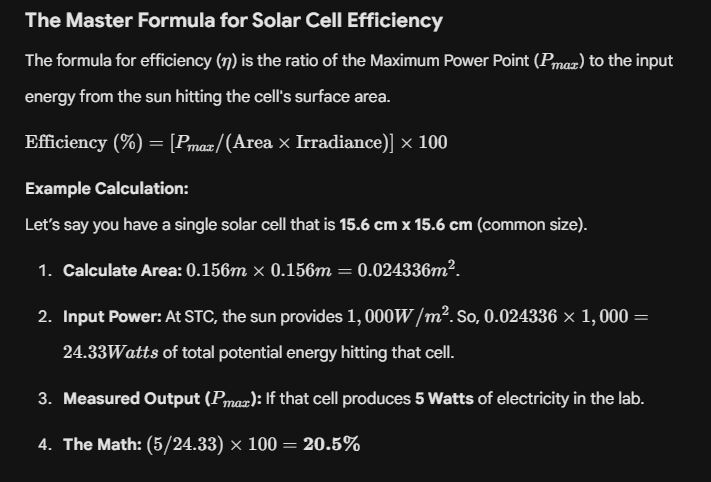
When you see a solar panel advertised, the first thing usually mentioned—besides the price—is the efficiency percentage. You’ll see numbers like 19%, 21%, or the high-end 23%. but what does that actually mean?
In the simplest terms, solar cell efficiency is a measurement of how much of the sun’s energy (photons) hitting the cell is actually converted into usable electricity (electrons). If a cell had 100% efficiency, it would catch every single bit of light and turn it into power. In reality, physics gets in the way, and much of that energy is lost as heat or simply reflected away.
If you are a student, a DIY enthusiast, or a homeowner trying to compare high-efficiency N-type cells vs. standard P-type cells, you need to know the math behind the curtain. Let’s dive into the solar physics.
The Lab Standard: STC
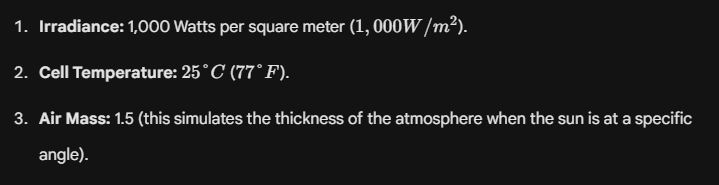
Before we calculate anything, we have to talk about STC (Standard Test Conditions). Because the sun’s intensity changes every minute, scientists use a “lab sun” to test cells fairly. STC assumes:
The Voc, Isc, and FF
To calculate efficiency, engineers look at three specific metrics from the cell’s performance curve:
- Voc (Open-Circuit Voltage): The maximum voltage the cell can produce when no current is flowing.
- Isc (Short-Circuit Current): The maximum current the cell can produce when there is no resistance.

Lab numbers are great, but what happens when the panels get hot or dusty on your roof? Use our Free Solar Panel Efficiency Loss Calculator to see how much production you actually lose to heat, tilt, and environmental factors.
Why isn’t Efficiency Higher? (The Shockley-Queisser Limit)
You might wonder why we aren’t at 50% or 60% efficiency yet. There is a fundamental physical limit for standard single-junction silicon solar cells called the Shockley-Queisser Limit.
Because of the way silicon interacts with the solar spectrum, the theoretical maximum efficiency is capped at roughly 33.7%. Energy is lost because some photons don’t have enough “punch” to move an electron, while others have too much energy, which just turns into waste heat.
Solar Cell Technology Comparison
Different materials and manufacturing processes result in different efficiency baselines. Here is how the most common US market options stack up.
Frequently Asked Questions (FAQ)
Is “Cell Efficiency” the same as “Panel Efficiency”?
No. Cell efficiency is always higher. When you put cells into a panel (module), you add “dead space” between the cells, a glass cover that reflects some light, and a frame. This usually drops the overall Panel Efficiency by about 1% to 2% compared to the individual cells.
Does efficiency decrease as the cell gets hot?
Yes. Solar cells are semiconductors, and they actually prefer cold, sunny weather. For every degree above 25°C (77°F), a typical silicon cell will lose about 0.3% to 0.5% of its efficiency. This is why proper airflow under your panels is so important.
Does a 400W panel with 20% efficiency produce more than a 400W panel with 18% efficiency?
No. They both produce 400 Watts. The difference is size. The 20% efficient panel will be physically smaller than the 18% efficient panel because it is better at converting light into power per square inch. High efficiency is mostly a benefit if you have a small roof.
What is Tandem Cell technology?
Tandem cells are the “next big thing” in 2026. They layer different materials (like Perovskite over Silicon) to catch different parts of the light spectrum. This allows them to break the 33% Shockley-Queisser limit, with some lab tests already reaching over 40% efficiency.